Vaporwave Text Generator — Wide Fullwidth Unicode Text
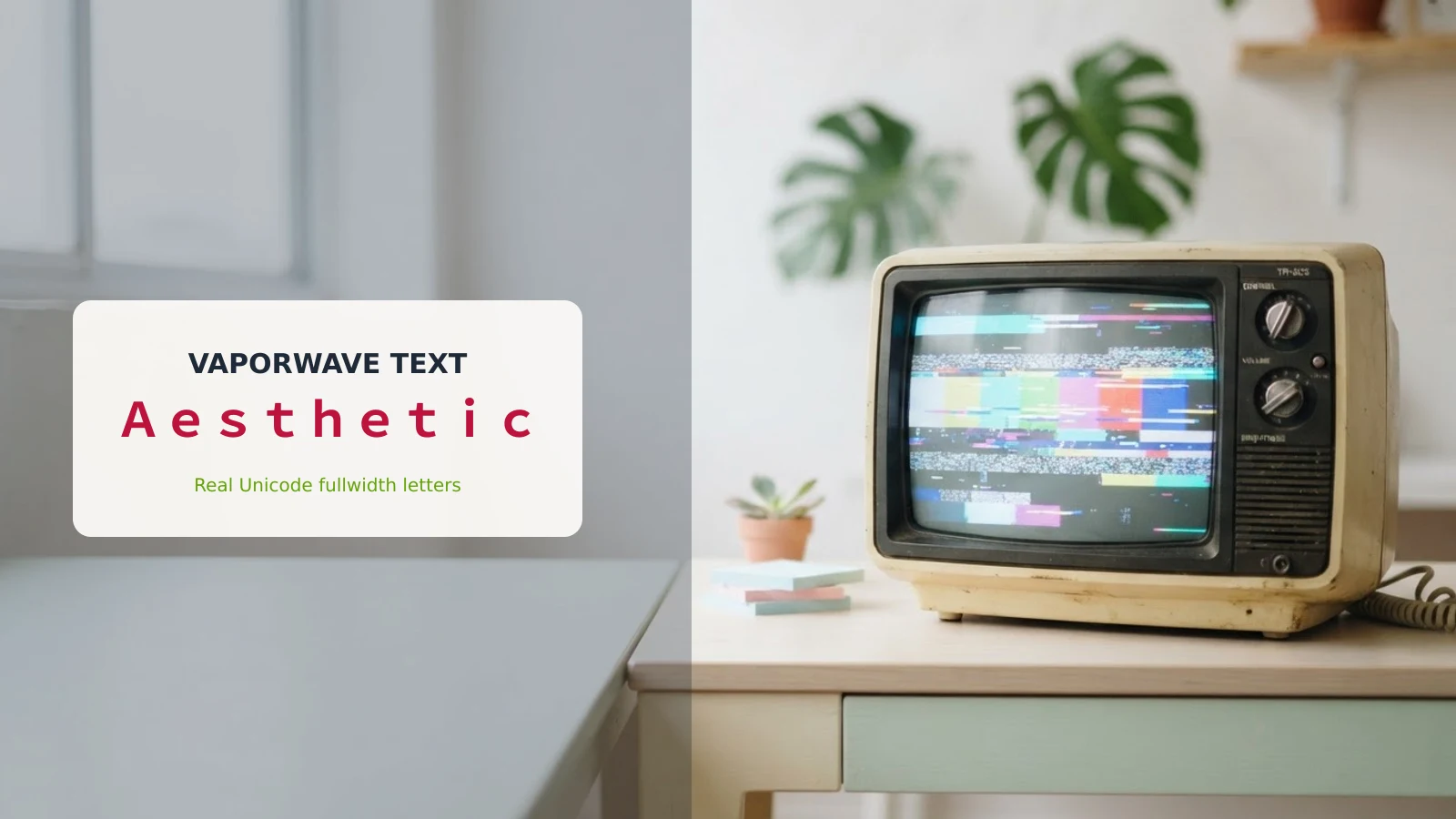
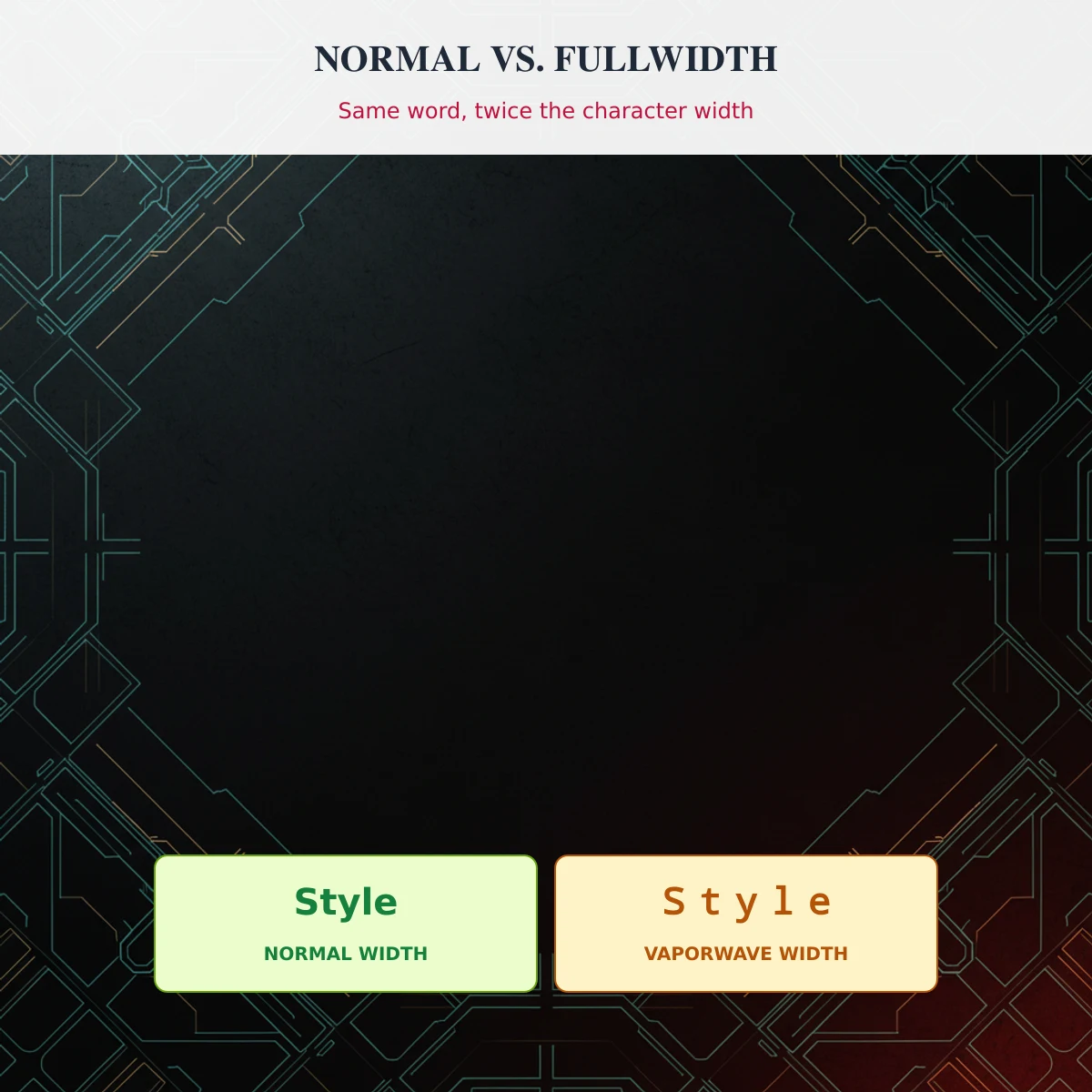
A vaporwave text generator maps ordinary letters onto Unicode’s Fullwidth Forms block — characters built for East Asian typesetting that happen to sit twice as wide as normal letters — so a word reads w i d e, spaced-out and glitchy, the signature look of vaporwave and aesthetic-core posts. Type a word once below and copy the result instantly.
Start typing above — every style updates instantly, right here in your browser.
Stylish Text
☆。・゚ Stylish Text ゚・。☆
▁▂▃ Stylish Text ▃▂▁
~*~ Stylish Text ~*~
Try one now
Six ready-to-paste wide/vaporwave examples — tap Copy and use as-is.
aesthetic
good vibes
y2k dreams
slow down
night drive
soft focus
Why it looks “vaporwave”
The Fullwidth Forms block (U+FF00–U+FFEF) exists so Latin letters can line up evenly in a monospaced East Asian document grid next to kanji or hangul — each character is drawn at roughly the width of a CJK character instead of its normal narrow Latin width. Borrowed outside that context, the effect is a word that looks stretched and spaced apart, which is exactly the aesthetic 1980s–90s Japanese-retail, glitch-art look vaporwave art revived in the 2010s. The space character in Fullwidth Forms ( , U+3000, “ideographic space”) is wider than a normal space too, which is why a Wide-converted sentence has noticeably more air between words than the original.
What doesn’t convert
Fullwidth Forms only maps the 26 Latin letters, the 10 digits, and a handful of common punctuation marks (the ASCII range, roughly). Anything outside that — accented letters like é or ñ, most symbols, emoji, and any non-Latin script — has no Fullwidth counterpart, so this generator leaves those characters exactly as typed instead of dropping or guessing a substitute. A word with an apostrophe, for example, keeps a normal narrow apostrophe sitting between two wide letters, which is a small but real inconsistency worth knowing about before you paste a longer sentence.
Pairing it with other styles
Unlike the overlay styles in the Styled Strikethrough & Underline group, Wide text isn’t designed to stack with a second style — a Fullwidth letter is a dedicated Unicode character in its own right, not a combining mark layered on top of another letterform, so there’s no “Bold Wide” or “Cursive Wide” the way there’s a Bold Underline. What vaporwave posts DO pair it with, almost always, is symbol framing — the converter above also includes three ready-made decorative frames (star-dust ☆。・゚, wave dash ~*~, and block fade ▁▂▃) built around the same widened text, which is the closest thing to a “second style” vaporwave text actually uses in practice.
Where vaporwave text displays
A style only shows correctly if the reader’s device has a font covering the characters it uses. We check this directly instead of guessing — full method on How We Test Display. Fullwidth Forms specifically depends on CJK font support being present, which is why its coverage can look different from the Mathematical Alphanumeric styles used elsewhere on this site.
| Style | iOS | Android / Linux | Desktop browser | Last checked |
|---|---|---|---|---|
| Wide / Vaporwave | Not checked | 0% of glyphs in Noto Sans — rest may show as boxes | 0% of glyphs found — rest may show as boxes | 18 Oct 2026 |
Desktop browser and Android/Linux columns are measured by checking whether common system fonts contain the Unicode characters each style uses — see how we test display. iOS has no equivalent font we can test here, so it stays "Not checked" rather than guessed.
Using vaporwave text on Instagram, Discord and more
Fullwidth Unicode text pastes into any field that accepts free text. On Instagram that’s your display name and bio — the @username field only accepts plain letters, numbers, periods and underscores, so a widened username is rejected at signup. Discord’s display name, server nickname and About Me field all accept it; the unique Discord @username does not. If you’re after a more legible-but-still-decorated look for a bio or caption, the mirror text generator covers a different kind of flipped styling.
Accessibility and SEO
Fullwidth Unicode letters are not read reliably by screen readers: because they are technically a separate character set designed for a different writing context rather than the Latin letters they resemble, many assistive technologies either mispronounce them, read them letter-by-letter with odd pauses, or skip them entirely, and search engines generally don’t treat them as equivalent to plain text either. Keep the wide/vaporwave look to captions and bios you’re decorating for yourself — not to headings, instructions or body copy everyone needs to read. See the full Accessibility page for detail.
FAQ
What is a vaporwave text generator?
A tool that maps your letters onto Unicode’s Fullwidth Forms block, the same wide-spaced character set used in East Asian typesetting, producing the stretched, spaced-out look associated with vaporwave and aesthetic posts.
Why does vaporwave text look wider than normal?
Fullwidth Forms characters are drawn at roughly the width of a CJK character instead of a normal narrow Latin letter, so every letter and the space between words takes up noticeably more room.
Does vaporwave text work with accented letters?
No — the Fullwidth Forms block only covers the 26 Latin letters, 10 digits and basic punctuation. Accented letters and non-Latin scripts have no Fullwidth counterpart, so this generator leaves them unchanged.
Is this the same as an “aesthetic font”?
It’s the same idea people usually mean by that phrase — not an installed font, but a Unicode character substitution that produces the wide, spaced-out look without any download.
Want to see every style family in one place? The full StylishText stylish text generator has all 60+ styles with the same real display testing.
Share your result or suggest a fix
Tested a style on a device or app we have not listed above? Tell us what you found (include the app, device and date) and we will review it before it is shown here.